A matheuristic solution for efficient scheduling in dynamic truck–drone collaboration

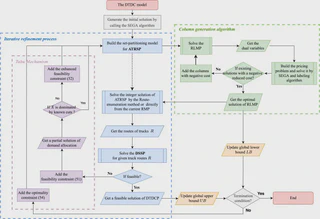 Image credit: Unsplash
Abstract
Unmanned aerial vehicles (UAVs), or drones, have great potential for emergency response operations in areas with vulnerable road networks and infrastructure. However, the low battery capacity restricts their quick, cost-effective, and efficient aerial transportation capabilities. To overcome this drawback, hybrid systems that combine trucks and drones have emerged as a promising solution. Nevertheless, the fixed-binding mode between trucks and drones in most studies tends to impair efficiency by limiting drones’ operational flexibility. This paper investigates a dynamic truck–drone collaboration (DTDC) strategy for efficient and flexible emergency response. This strategy enables drones to dynamically change take-off and landing locations on different trucks, which is beneficial in emergency scenarios with common road network disruptions. Despite its advantages, the DTDC strategy introduces additional complexity to the scheduling problem, resulting in a time-consuming solution. To enhance solution efficiency and improve the application prospects of this strategy, we propose a matheuristic to decouple DTDC’s multiple synchronization constraints, separating the scheduling problem into three decision-making processes: demand allocation, truck routing, and drone scheduling. Additionally, two alternative matheuristic algorithms are designed to target accuracy and computing efficiency, respectively. The empirical results indicate that the proposed heuristics outperform the state-of-the-art solver and several metaheuristics. A sensitivity analysis confirms that improvements in drone endurance and the strategic reservation of drone parking slots on trucks can significantly improve the DTDC strategy’s performance.
Type
Publication
In Expert Systems with Applications
