Learning-Based Heterogeneous Autonomous Vehicles Scheduling for On-Demand Last-Mile Transportation

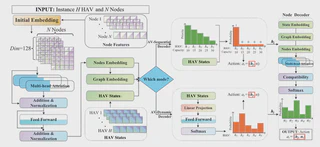 Image credit: Unsplash
Abstract
Last-mile transportation, a critical component of public transit within integrated urban mobility systems, plays a pivotal role in promoting sustainability and requires immediate attention. However, due to the high real-time variability and uncertainties of last-mile travel demand, high passenger concurrency, and dispersed destinations, existing last-mile transportation systems often encounter significant challenges. These challenges include resource shortages and congestion during peak hours, as well as high operational costs and excessive passenger waiting times during off-peak periods. With the rapid development and widespread adoption of autonomous vehicles, which are characterized by centralized control and flexible scheduling, this study proposes leveraging heterogeneous autonomous vehicles to address these challenges. Specifically, a mixed-integer programming model is developed to maximize the service provider’s profit by considering fare profit, passenger waiting time penalties, and operating costs. To enable real-time decision-making, then an attention-based deep reinforcement learning algorithm is introduced. This algorithm incorporates two decoder mechanisms for vehicle selection and passenger allocation in the scheduling of heterogeneous autonomous vehicles. This involves dynamically selecting vehicles from a heterogeneous fleet based on passenger demand using an attention mechanism, optimizing efficiency in serving last-mile travelers. Extensive numerical experiments and a real-world case study across various datasets demonstrate that the proposed service model and algorithm effectively solve the scheduling problem while meeting the demands of on-demand last-mile transportation. Furthermore, these innovations contribute to reducing fleet carbon emissions and advancing sustainable urban transportation. Note to Practitioners—Last-mile transportation systems face critical challenges: overcrowded vehicles during peak hours, high costs due to underused resources in off-peak periods, and passenger dissatisfaction from long wait times. These issues hinder sustainable urban mobility and strain transit operators’ budgets. This work addresses these problems by deploying heterogeneous autonomous vehicle fleets with varying sizes and capabilities for last-mile transportation. The proposed system dynamically assigns vehicles to passengers based on real-time demand, optimizing efficiency while reducing operational costs. For transit operators, this approach balances fare revenue with penalties for passenger delays, ensuring profitability even during fluctuating demand. Cities adopting shared autonomous vehicle services can benefit from reduced congestion and lower carbon emissions, aligning with sustainability goals. Our experiments validate that the method improves service reliability and fleet utilization across demand scenarios. Implementing this solution requires integrating demand prediction tools with a centralized autonomous vehicle dispatch platform, compatible with existing mobility apps. Future extensions could adapt the system to mixed fleets (combining autonomous vehicles with traditional vehicles) or expand to multi-city networks. By addressing both economic and environmental needs, this framework offers a scalable path toward smarter, greener urban transportation.
Type
Publication
In IEEE Transactions on Automation Science and Engineering
