Data-Driven Electric Vehicle Fleet Sizing for Airport Baggage Transport via a Two-Stage Shareability Network

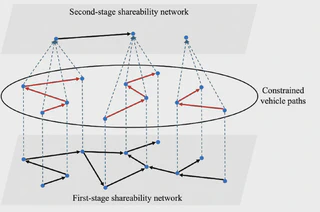 Image credit: Unsplash
Abstract
The strategic planning of fleet size plays a crucial role in driving the electrification transition of airport baggage transport services, thereby fundamentally supporting sustainable aviation and achieving cost savings. However, electric vehicle fleet sizing in airport baggage transport services is challenging due to daily demand fluctuations, battery capacity constraints for electric vehicles, and the need for large-scale decision-making in busy airport environments. To address these challenges, this paper develops a data-driven two-stage shareability network framework that utilizes historical daily flight schedules. Specifically, in the first stage, the spatial–temporal baggage transport demands are modeled as a shareability network, and vehicle paths are generated using a maximum matching algorithm without considering battery capacity. Then, three path-cutting strategies are proposed to address the driving range constraints resulting from the limited battery capacity of electric vehicles. Finally, the second-stage shareability network, which integrates recharge opportunities, is constructed through node augmentation, enabling the simultaneous determination of fleet size, vehicle paths, and charging plans via maximum matching. Extensive experiments using real flight data from Hong Kong International Airport validate the performance of our approach in large-scale problems. In addition, the performance of three path-cutting strategies, and the impacts of the electricity consumption rate and depth of discharge on the electric vehicle fleet size are examined through experiments. In general, this paper contributes to the literature on the electric vehicle fleet sizing problem and offers practical guidance for the adoption of electric vehicles in the aviation industry.
Type
Publication
In European Journal of Operational Research
